
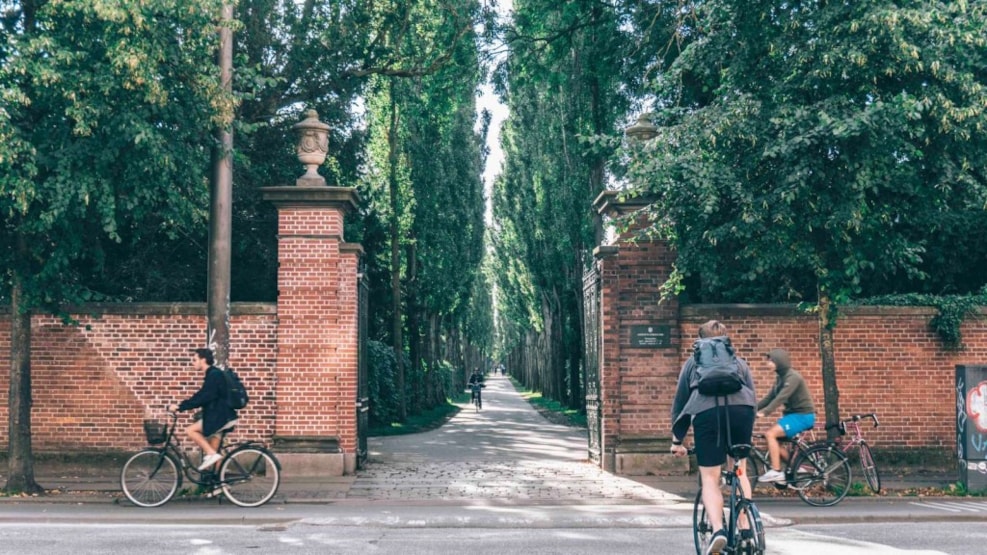
In the middle of Copenhagen, in the area called Northbridge (Nørrebro), you find a church yard called Assistens Kirkegård. This used to be the main church yard for Copenhageners in the last century, and many known people are buried here.
One of the internationally most famous people buried here is the philosopher Søren (or Soren) Aabye Kierkegaard. Søren Kierkegaard was born on May 5, 1813, and died November 11, 1855. Within those 42 years he managed to leave a mark of dimensions, as a philosopher, theologist and author.
Søren Kierkegaard considers man's main question what he wants from his life, both through need and opportunity. Frankly, it reminds me of part of the curriculum of my Human Ressource Management classes at Copenhagen Business School. The narrowing tunnel of opportunities available to you, as you make your carreer choices, and Maslow's pyramid which goes from needs that have to be fulfilled at the bottom of the pyramid before you get up to the wants.
Trying to read Søren Kierkegaard in the original presents problems. Not that his choice of syntax is problematic, it's his constant quoting texts in their original language. Besides Danish, one needs to have an intimate knowledge of the Greek language in its original letters, as well as Latin. It is very obvious that Søren Kierkegaard's background is in theology.
The text on the plaque translates, as I see it, as follows: "It's just a short time, then I have won. Then the whole strife is completely gone. Then I can rest in halls of roses and incessantly talk with my Jesus". Kierkegaard seems to have considered his time on Earth a rather trying one.
It seems that not many understood him while he lived. He was scheduled to speak in Studenterforeningen at one time, but members of the student club published a not very flattering "skillingsvise" about him, which made him so mad that he cancelled. In the days of no TV or radio (believe it or not - there has been such a time) the main place to discuss academic works and subjects in Copenhagen was Studenterforeningen. Kierkegaards choice never to appear there illustrates how unappreciated he was among his peers.
Still, he didn't exactly pussyfoot about, himself. One of his early works is a book called "Af en endnu levendes papirer" or "Of the papers of one yet living". It is basically a viscious attack on Hans Christian Andersen's third novel "Kun en spillemand" or "Only a fiddler", which was published in 1837. The most interesting aspect of this book is that you can spot his ethical points of view, which later have made him so famous. Attacking an author like Hans Christian Andersen, who was already a celebrity at that time, was a distinct social no-no, and an illustration of his rebellion against his contemporary society.
Assistens Kirkegård is no longer "just a cemetary". Due to its location in the middle of a combined business and residential neighborhood, it is today used both as a church yard and a park. In summertime, it is very common to sunbathe on the grass around the graves.
It is not uncommon for regular visitors to have a favorite grave, where they do their sunbathing.
Find your usual grave, remove unnecessary clothing and catch some rays. The locals have a very relaxed attitude towards the church yard, which is rather comforting, as it indicates a serene attitude towards death and dying.
Note that the grave of Hans Christian Andersen will also appear in this picture thread at a later date, as he is also buried here.